Hormuz and the Hidden Risks to Pharma Supply Chains

The conflict in Iran has illustrated that it’s not just the industry’s reliance on Indian APIs that creates vulnerabilities for pharma supply chains.

The US and Iran may be closer to a deal as a fragile ceasefire just about stands, but uncertainty over supplies isn’t going away any time soon.

President Trump has announced he is stopping US operations to escort stranded vessels out of the Strait of Hormuz in order to firm up a deal with Iran, but the US blockade of Iranian ports continues.

More than 20 ships have been attacked near the Strait of Hormuz since the start of the conflict. On the same day as the US President announced the ceasefire extension, Iran said it had seized two cargo ships in the strait, which it refuses to open due to the US naval blockade.

While it stays closed, an oil crisis is rapidly escalating into a more profound chokehold on global supply chains.

Pharmaceutical Supplies Face Shortages

Even in March, UK commentators were warning of imminent issues for the supplies of generic medicines.

As Moody’s analytics director of supply chain management told the Guardian, “It's the perfect storm. We have the conflict in the Gulf that caused the Strait of Hormuz to shut down and India is known as the pharmacy of the world.”

The Iran conflict has also hit at a time when supply chains were already under strain. As far back as December, Aspirin shortages were already being felt in the UK, for example. By January, a National Pharmacy Association (NPA) survey was finding that 86% of pharmacies could not fulfil aspirin requests.

Drug shipments headed to the Middle East have been affected first, but Western markets are also vulnerable, particularly where there is a dependence on one geographic region for an API. And even while supplies continue, costs are escalating.

“While we are not currently seeing exceptional shortages, manufacturers are facing sharp increases in transportation costs, particularly for air freight,” Mark Samuels, Chief Executive Officer at Medicines UK, said back in March.

The switch from higher prices to all-out shortages could be rapid, however. The head of NHS England told LBC he was “really worried”, given the country relies on imports for three quarters of its drug supplies. Already, some drugs, such as those used to treat Parkinson’s, are experiencing supply issues.

Generic Dependencies

As Moody’s analysis indicates, much of the issue is modern dependence on India for generic medicines and active pharmaceutical ingredients (APIs). That, of course, is not news, and has long been a concern before most of us could have pointed to the Strait of Hormuz on a map.

The dependence on India (and China) is well recognised – if not easy to address.

It’s not just Western dependence on India and China at question, either, but dependencies between the two. India (the world’s biggest generics exporter) depends on the Strait for much of the crude oil imports its pharma businesses rely on, but also for chemical raw materials produced in China. These are often consolidated in Dubai and the UAE and then shipped to India.

As this piece details, even in mid-March, amoxicillin trihydrate (a penicillin API) prices were up 45% in a week; paracetamol active pharmaceutical ingredient prices increased 26%; diclofenac sodium (used in anti-inflammatory NSAID) rose by as much 30% percent; and ciprofloxacin (fluoroquinolone antibiotic) prices were up by as much as 30% since December.

In the UK, meanwhile, shortages of carbon dioxide, which has myriad uses, including in medical procedures, prompted the government to invest £100m to reopen a manufacturing site for the gas that was mothballed last September.

Solvents and Hidden Supply Chain Vulnerabilities

The crisis has highlighted the complex nature of modern pharmaceutical supply chains and multiple points of vulnerability. The dependencies on key APIs have long been obvious; pharma companies will know their exposures off the top of their heads. But aside from APIs, what about acetonitrile, the solvent that “runs through nearly every HPLC [high-performance liquid chromatography] and LC-MS [liquid chromatography-mass spectrometry] in every lab and QC [quality control] suite in every pharmaceutical company on earth”.

As the writer puts it, “[F]or researchers, pharmaceutical chemists and CDMO production teams, the real concern is different and more immediate: the reagents, solvents, and process chemicals used daily in synthesis, purification and analysis – almost all of which connect, within a handful of synthetic steps, to Gulf feedstocks.”

The piece details the escalating impact as disruption continues:

As the writer makes clear, supplies don’t need to dry up for there to be a problem, and the crisis isn’t just for generics: “For academic groups on fixed grants, CROs pricing fixed-fee contracts, and CDMOs managing campaign economics, this kind of systemic cost inflation is harder to manage than any single shortage, because there is no single substitution that resolves it.”

See Dependencies with Supply Chain Risk Management Software

These are, though, new wrinkles to old and widely recognised problems. And they are not going away, whatever happens with the Iranian ceasefire and flows through the Strait of Hormuz.

As we’ve seen countless times, reliance on global sources is essential for constraining costs of generic drugs right across pharmaceutical supply chains. Critical dependencies are difficult to untangle, and not all vulnerabilities can always be managed. At the very least, pharma businesses cannot escape rising prices.

But visibility of the supply chain, dependencies, vulnerabilities, pinch points and, crucially, value at risk is essential. Without it, businesses are unable to distinguish between avoidable and unavoidable vulnerabilities or make informed decisions about where to invest in mitigation or insurance.

The issues around solvents and reagents, in addition to APIs, highlight the difficulties of achieving this without using the technological tools available. Solutions such as SCAIR® are designed to enable organisations to have the end-to-end visibility of supply chains that they need. They can then identify common dependencies on APIs or manufacturing sources to plan alternatives, and the key – and potentially not obvious – vulnerabilities in their supply chains. They can, crucially, also calculate the value at risk to make informed decisions about mitigation and insurance.

When dealing with complex supply chains and a volatile world, such tools give the best chance of navigating your business through dangerous waters.
Out and about at CPhI Worldwide

Greetings from Frankfurt where we've been at CPhI Worldwide.

We’re just returning from a successful week taking SCAIR to 36,000 pharmaceutical professionals.

You don’t have to be at the conference long to appreciate the importance of technology: The event brings in participants from every part of the pharmaceutical manufacturing and delivery, with over 20 dedicated zones covering ingredients, APIs, excipients, packaging, biopharma, machinery and so on. There are also participants from over 150 different countries.

Visiting this conference, it’s impossible not to get a sense of the both complexity of the modern pharma supply chain and its truly global nature. With new innovations announced every day at the conference, you also get a sense of how fast moving it is.

CMO uncertainty

And you get a sense of the risks: The annual report of the event’s organisers picks up on some of these, including including political uncertainty in the US, with a new administration that has shown a “keen political desire… to reduce drug prices, but with very little indication of policy”.

That’s left pharma companies and the contract manufacturing (CMO) “in the dark”, the report notes, and vulnerable to decisions that could disrupt their entire business model.

We’re at CPhI to show how technology such as SCAIR can address this type of risk, as well as more long-standing challenges that affect operators across continents and across the supply chain.

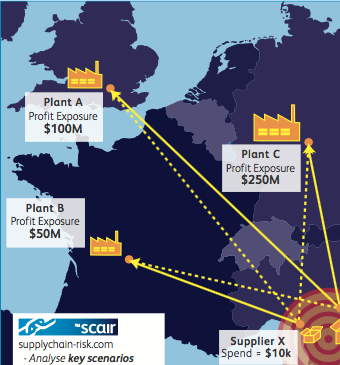
We don’t pretend to be able to control Trump, but SCAIR can enable businesses to quickly get to grips with the impact any changes may have. With the software they can visualise their end-to-end supply chains and quantifying accumulated exposures of the company’s product portfolio to each critical supply point.

Nat cat and compliance

This Supply Node Exposure module in the software is also used to identify locations critical to the company for natural catastrophe alerting. Warnings and reports of hurricanes, earthquakes and floods are overlaid on these locations to rapidly highlight potential losses.

Finally, SCAIR deals with another key concern across the industry and highlighted frequently at CPhI: Compliance. It collects and consolidates non-compliance and supply chain interruption information from leading regulators such as the FDA and EMA. Root cause analysis of data such as recalls, production shortages, enforcement actions helps avoid issues in future.

As fast as the industry changes, events like CPhI make it clear these traditional concerns, along with issues such as maintaining data integrity and good manufacturing practice, continue to be key. It also suggest, though, that those companies that tackle them successfully, can look forward to the future with considerable confidence.

Puerto Rico is hit again

The thing about the hurricane season is it’s always easy to speak too soo.

We noted a couple of weeks ago that Puerto Rico, a key production centre for pharma manufacturers, had escaped the worst of hurricane Irma.

Yet the clean up wasn’t even finished when the island was hit by the worst storm in 80 years, Maria, bringing “total devastation”. A number of factors have left the island particularly hard hit: Already fragile infrastructure leaving most without electricity – for weeks and many possibly for months; even cell phone coverage is limited; and widespread flooding has been exacerbated by the failure of the Guajataca Dam. The island also already filed for bankruptcy earlier this year, leaving it poorly prepared to tackle the costs of getting back on its feet.

Hurricane Maria might also have proved that it was a bit early to congratulate the industry and governments for avoiding drug shortages following Irma and Harvey. On Monday, the FDA warned that shortages could occur if the Puerto Rico pharma industry wasn't helped to get up and running quickly.

“The island is home to a substantial base of manufacturing for critical medical products that supply the entire world. This industrial base is an important source of jobs and economic vitality for the island. It is a key to Puerto Rico’s economic recovery. The manufacturing facilities are also a pivotal source of critical medical products for the entire United States,” its statement read.

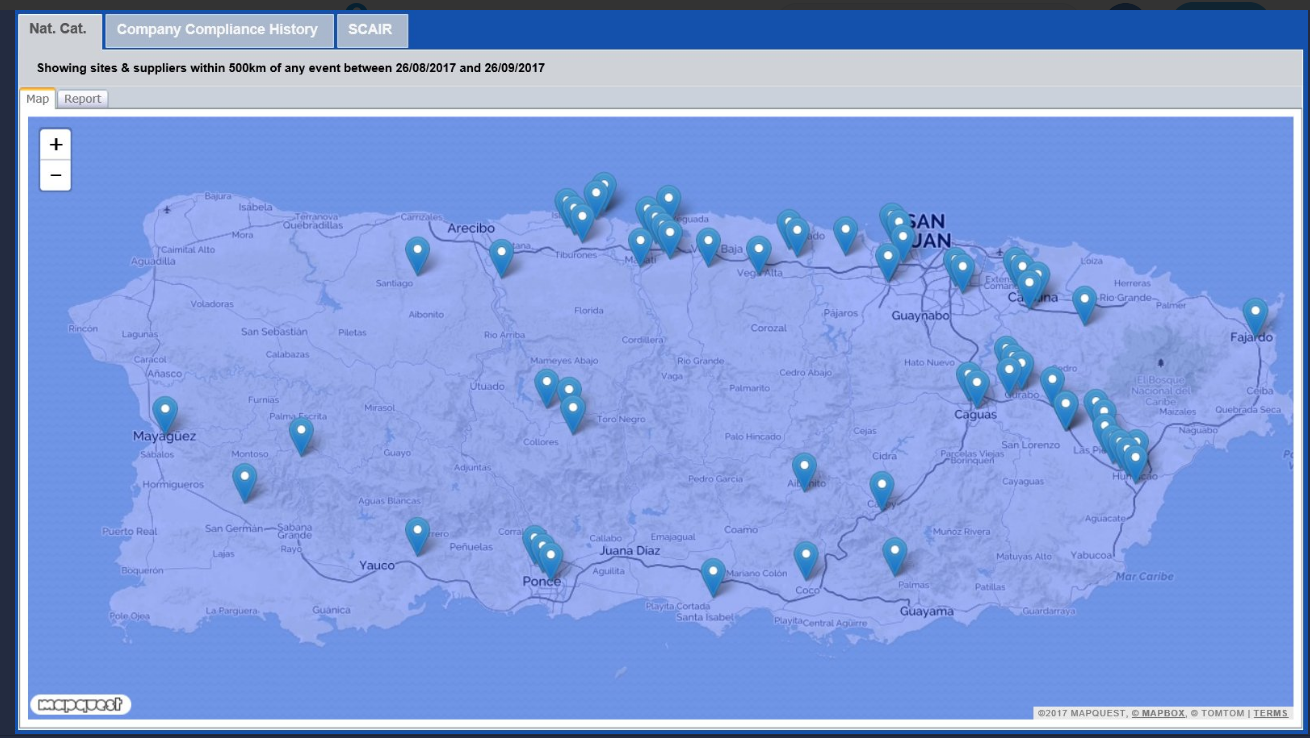
The problem, as ever, is both the scale of the storm – a “catastrophic event unlike many the United States has faced”, as the FDA put it – but also the scale of pharma manufacturing in Puerto Rico. That’s shown in a map taken from the tool in our SCAIRTM software of FDA Registered Drug Establishments affected:

With such a concentration in an area so prone to tragedy, the challenge for the industry to maintain supplies will alway be substantial.

When the storm comes

Hurricane Irma once again shows us the importance of mapping supply chain risks for the pharmaceuticals industry.

The storm has passed, but the effects will be felt for months to come. In the Florida Keys up to a quarter of homes in the low-lying islands are reported to have been destroyed. Many in the Caribbean have had it worse.

There will, as always, be lessons for industries, including pharma. Puerto Rico, for example, is a huge centre for pharma manufacturers – the fifth biggest in the world with more than 80 plants. It accounts for about a quarter of the country’s GDP.

The island was actually spared the worst of the hurricane, but still three died, 50,000 were left without water and 600,000 without power. The storm served once again to expose the fragility of the island’s infrastructure. Nor are hurricanes the only recent disruption to hit the island. Only at the start of the summer did it declare its outbreak of the Zika virus over, after it infected more than 40,000.

Weather risk: an unavoidable reality

It’s not just Puerto Rico, of course; Irma brought potential for disruption across the Caribbean, to Florida and on inland. And it’s not just Irma; it followed hard on the heels of hurricane Harvey.

The industry has got better in recent years at dealing with these events, not least because of government encouragement to avoid disruption to medical supplies that can exacerbate the tragedy. One of the untold stories of both hurricanes Harvey and Irma is the shortage of urgently needed medicines; untold, because the problem was largely avoided with some improved planning.

But we’ll be tested again. Yes, hurricane Irma was unusually strong, but we’ve seen storms this powerful – and perhaps more so – before. We’ll see them again. The role of climate change in developing such storms will continue to be debated. What’s unarguable is that pharma – and a wide range of other industries with global supply chains – will always be at risk of exposure.

Preparing in advance for real resilience

Modern technology is a big part of the answer to managing this risk. The information businesses and the public have on a hurricane’s trajectories and strength is unparalleled; they can now track it online in real-time. Combine that with modern software solutions and we can quickly map risks for at-a-glance understanding of exposures.

That’s always useful in directing emergency responses when the storm comes. It’s more useful, though, used to map exposures and build resilience through continuity plans before. The power of Irma may have been a surprise, but storms in the hurricane season are not. Fortunately, we have the tools to weather them well; we just need to make sure we use them.

Brexit and the pharmaceutical supply chain

There’s work to be done on all sides – not just by the negotiators – to prepare supply chains for a future outside the EU.

For anyone already sick of Brexit, Michael Barnier’s recent announcement won’t have been encouraging: “The hard work starts now,” the EU’s chief negotiator Michel Barnier told reporters – more than a year after the UK voted to leave.

It’s a big issue – and a particular challenges for some.

One is the pharmaceuticals industry, and a couple of days before Michel Barnier was urging the UK to knuckle down, leaders in the UK and EU pharmaceutical industry were issuing a warning to both Barnier and Britain’s Brexit Secretary David Davis of the risk to supplies of life-saving medicines.

“In the case of an unorderly withdrawal, there is a risk that all goods due to be moved between the UK and EU could be held either at border checks, in warehouses or manufacturing, and/or subject to extensive retesting requirements,” the letter warned.

And it’s not just the industry that’s worried. The week before, the UK’s health secretary and its business secretary called for continued co-operation with the European Medicines Agency after the UK left the EU – “in the interests of public health and safety”.

Preparing your supply chain

Hopefully, these warnings will have their desired effect, and arrangements – transitional or otherwise – will be in place when the negotiations finish. In that case, this will all be put down as a crisis averted or just another “scare story”, according to taste.

As we’ve noted before , though, whatever happens Brexit will be a game changer not just for pharma but for all businesses. The currency volatility we’ve already seen could well return as the deadline for negotiations gets nearer; the regulatory framework remains uncertain; and supply chains are going to have to get more complex – perhaps in the short-term, as contingencies are put in place, or in the long-term to deal with new realities.

Many companies have already made changes to their supply chains to make them more resilient to whatever results from the negotiations; many other are still looking but have at least gained an understanding of the risks they face and the vulnerabilities in their supplies. For any that haven’t made much progress, though, or those that haven’t even begun, the hard work truly does need to start now. Time is not on our side.

The long road to continuous manufacturing in pharma

Continuous manufacturing could have significant success in improving the pharmaceuticals supply chain, but challenges remain.

The journey to continuous manufacturing in pharmaceuticals is going to be a long one. As a recent report on another, related technology – 3D printing – made clear, the shift to continuous manufacturing in pharma has been “slow”. Most still hold to traditional batch processing methods.

That’s despite the benefits it potentially provides – proven in a wide range of other industries like oil, gas and petrochemicals. Most notably, perhaps, is efficiency: Frost & Sullivan’s report notes that continuous manufacturing can cut production time to less than 10 days (which could then be further cut with 3D printing); the US Food and Drug Administration (FDA) has estimated some drugs that take a month to manufactured through batch processing, could be produced in a day.

Linked to that, continuous manufacturing also promises to cut manufacturing costs: by up to 40 to 50 per cent, according to the US National Science and Technology Council’s Subcommittee for Advanced Manufacturing. Estimates put waste from inefficiency in the pharmaceutical industry at up to $50 billion a year.

A quality argument for continuous manufacturing

Finally, continuous manufacturing has the potential to improve quality. Reducing human input – and error – from production, it could help cut contamination and mistakes that lead to waste and product recalls. And it’s not just the technology companies making that case: it’s one reason the FDA has been keen to accommodate uptake of continuous manufacturing.

As the deputy director in the FDA’s Office of Pharmaceutical Quality, Center for Drug Evaluation and Research, has put it: “[B]y eliminating breaks between steps and reducing opportunities for human errors during the stops and starts in the batch process, continuous manufacturing is more reliable — and safer.”

In short, continuous manufacturing could help address both drug shortages and recalls from production issues: two key supply chain challenges the industry faces.

Demand for data

So, if it’s faster, cheaper and results in better quality, why has the move to continuous manufacturing been so slow?

There are a number of reasons. One is the up front costs, with the need to invest in new equipment. For some producing small quantities, it may also be difficult to justify round-the-clock production.

But there is also the fact that the move to continuous manufacturing is demanding – and potentially risky if not handled correctly. The benefits to quality, particularly, are achieved only by building it into the continuous process at the outset – so called “quality by design”. Regulators, too, must be satisfied that the process and controls in place are adequate.

Two things are particularly important to meeting that challenge, and both were picked up on in a speech earlier this year by Stephanie Krogmeier at Vertex Pharmaceuticals.

First, is the data challenge that continuous manufacturing can bring, ensuring the right information is available to control the process and satisfy regulators. The move to continuous manufacturing and increased oversight of data are closely tied in the FDA’s approach.

Second, and possibly even more important, is leadership. As Krogmeier made clear, the move to continuous manufacturing needs commitment, and that has to start at the top. As she said: “You need the full support of management. If you don’t have someone in senior management driving this, you will fail.”

Going local? Brexit, Trump and supply chain challenges

Businesses have a window of opportunity to make preparations for a more protectionist future. It will not be open forever.

John Major’s intervention aside, a hard Brexit remains the government’s position on the EU, and industries are starting to take note. Today, The Times reports UK car manufacturers are looking to source more parts domestically in response to the threat of tariffs when the UK leaves. Over time, the current ratio of two thirds sourced internationally to one third at home may be reversed.

The concerns are not restricted to the UK, nor worries over Brexit. Going local was a key message at this year’s Davos meeting of the World Economic Forum, as businesses try to pre-empt a Trump-led populist backlash against globalisation.

America first: bringing production home

Furthermore, while they’re particularly exposed, it’s not just car makers in the firing line. According to the new head of the President’s National Trade Council, repatriating international supply chains is a priority for the new administration.

“It does the American economy no long-term good to only keep the big box factories where we are now assembling ‘American’ products that are composed primarily of foreign components,” Peter Navarro told the Financial Times

“We need to manufacture those components in a robust domestic supply chain that will spur job and wage growth.”

In the UK, meanwhile, the Road Haulage Association has warned of fresh food rotting as Brexit “cripples” supply chains – tariffs or no tariffs – if the right customs controls aren’t in place.

Time to future proof the supply chain

We’ve noted before that predictions about the impact of Brexit are particularly unreliable. Confirmation the UK will exit the single market and full membership of customs union have given us some indication of what to expect from Brexit. Until negotiations get well underway, however,  and even then, there will continue to be massive uncertainty as to the final trading relationship, tariffs and customs arrangements in place.

The same is true to an extent in the US. Despite the frantic activity of the Trump administration, it will be some time yet before it becomes clear to what extent Trump wants – and can – pursue an isolationist trade policy.

These are not reasons to wait, though. Rather, they give time to act – and it may end up being a narrow window of opportunity. The speed and size of currency movements since the Brexit vote has already shown how quickly things can move. Likewise, in the US, should some of the more worrying potential consequences of the new administration’s policies and rhetoric materialise, they could do so quickly.

If organisations don’t yet have the confidence to anticipate the future trading landscape, they do at least have sufficient warning that changes are on the way. They need to be building resilience in their supply chain now – ensuring they have the visibility and flexibility to react when the time does come.

No lucky strike for supply chains

It’s a new year, but the problems for supply chains are much the same. Among them, increasingly, is industrial action.

December drew comparisons with the Winter of Discontent with strikes or threats by Post Office staff, train and tube drivers, airport workers, and even Argos delivery drivers. With the tube strikes this week, that discontent has followed us into 2017.

As others have noted, comparisons with the 1970s are overplayed. It actually became harder for unions to take legal strike action in the UK last year, for example, with the passing of the Trade Union Act in May. Unions now require a ballot turnout of at least 50% for industrial action – and 40% support of all eligible to vote when it comes to vital public services such as health, education, transport, border security and the fire brigade.

Nevertheless, recent activity does suggest something of a resurgence in the UK following a near-record low in the number of days lost to industrial action in 2015. The action we’ve seen also has significant impacts. Academics estimate the Southern Rail strikes alone have cost the UK £300 million. The tube strikes this week may even cost the same, according to some of the higher estimates.

Moreover, while levels of UK industrial action have trended downward in the last few decades and remain modest, they’re much higher elsewhere, including in some of our near neighbours. France, Denmark, Norway, Belgium (which saw a particularly high number of strikes last year), Spain, Finland and Ireland have all lost anything from double to seven times the number of days as the UK to action in recent years. If businesses are not directly affected themselves, others in their supply chain may well be.

All of which is simply a reminder that industrial action remains a key threat to the supply chain. Businesses need to build in resilience and redundancy to account for it, and to do that, they need to have an accurate view of their exposures.

More than words: slavery in the supply chain

It may not seem it, but the deadline for company’s statements on tackling modern slavery is deadly serious. Businesses need to be sure they know what’s happening in their supply chains.

Human rights is the number one corporate social responsibility issue in supply chains, according to a recent survey. It ranks ahead of even environmental concerns and traceability when it comes to identifying essential concerns in the coming year.

It’s hard to argue with this: Human rights are a key focus of not just consumers, but also government in attempting to crack down on abuses. And one key example is regulation to fight modern slavery.

The end of September marked the “deadline” for big organisations with a financial year ending in March to publish their modern slavery statements. In the statements – introduced by the Modern Slavery Act 2015 – organisations supplying goods or services with a global turnover of £36 million are expected to set out the steps taken to ensure modern slavery is not taking place in their business or supply chains.

A light touch

On the one hand, the requirement doesn't seem too taxing. It is, for instance, a “soft” deadline: government guidance says only that businesses should publish their statements “as soon as reasonably practicable” after the end of each financial year, and “encourages” publication within six months – hence the end of September cut-off for those with financial years ending in March.

This is, as others have pointed out, “a light-touch approach”, and some of the initial efforts seem to reflect a failure to take the new rules seriously.

According to one analysis of the statements submitted so far, most fail to meet minimum standards the Act sets out. The majority, for instance, are not signed by a company director or are not available from the company’s website homepage – two basic requirements.

No excuse not to know: time for supply chain transparency

Nevertheless, the advent of these statements is an important milestone.

For a start, the availability of statements from hundreds of companies introduces a benchmark by which policies can be assessed. They are also likely to be pored over by campaign groups, including those focused on “strategic litigation”, bringing cases in the civil courts to penalise abuses.

Finally, more moves against slavery in the supply chain can be expected, with Theresa May recently reiterating her commitment to the issue as Prime Minister.

Given all that, statements are going to be more than just a PR tool. Some, according to the UK’s Anti-Slavery Commissioner, are likely to end up as evidence of whether companies ought to have known slavery in their supply chains was taking place – making them guilty of a criminal offence.

The statements are really just the start; businesses need to be sure they have the visibility and processes to root-out abuses in the supply chain.

As Theresa May wrote when she was Home Secretary overseeing the introduction of the Modern Slavery Act: “It is simply not acceptable for any organisation to say, in the twenty-first century, that they did not know.”

The Brexit case for proactive supply chain changes

EU vote has brought risks, but also opportunities. It’s time for a review.

Brexit is among the factors pushing supply chain risks to a three-year high, according to a new survey. The Chartered Institute of Procurement and Supply quarterly Risk Index is up one point on last quarter, and up almost two on last year to reach 80.8 (out of 100).

Two months on from the EU referendum, however, we’re actually little closer to knowing what Brexit will mean.

With the government still not invoking Article 50 (despite some pressure), negotiations for the UK’s withdrawal from the EU have yet to even begin. Theresa May has said it will not be triggered this year, and there is “idle chatter” of further delays – perhaps until after the French and German elections in May and September, respectively.

In the absence of those negotiations, we’ve no way of knowing the likelihood of any of the various options: whether we’ll end up with someone similar to Norway’s membership of the EEA or an entirely new arrangement – a “special status”.

In one sense, then, we’re no further on than when we last looked at this issue. Yet, the intervening period has been useful in a couple of respects.

Supply chain risks sooner rather than later

First, it’s shown us that some of the more dire speculation about the impact of Brexit was just that. Both unemployment and retail sales figures have so far confounded the doom-mongers. There’s no guarantee that will last, but it makes it clear that predictions about the impact from Brexit are unreliable.

It also makes it clear that there’s still time to make changes to respond to a new environment. But that window could close soon.

For many, the risks need to be monitored closely well before the final parting. As a recent report by Credit Suisse makes clear, for instance, many UK exports are not goods being sold to consumers but components used by EU manufacturers’ products. Those EU producers are likely to be reviewing their supply chains now, even if you are not.

“Indeed, the risk is that the current uncertainty surrounding the UK’s membership of the EU may be sufficient for some EU companies to slowly shift sourcing parts of their value chains away from the UK. As such, the negative effects on UK export demand may occur sooner rather than later,” the report notes.

Making the most of Brexit

But Brexit also presents opportunities. Whether it forces you to or not, Brexit probably should change your supply chain – or at least make you consider changes. A lot of companies have taken this to heart, with a survey of retailers by Barclays showing many looking to new sources.

In fact, the Brexit vote – like any big change – is a prompt to review the supply chain to check its robustness and its efficiency, because where there are risks, there are also often opportunities. It’s better to try to address both early on.