• Home
  • Product Details
  • Next Steps
  • Contact Us
  • Partners
  • Blog
SCAIR
  • Recent Posts

    • The Hardening Attitudes of Reinsurers to Unspecified Suppliers
    • Thailand Floods Devastate Hard Disk Drive Supply Chains
    • Could the Impending ‘Solar Max’ be the Next Disaster to Hit Global Supply Chains?
    • Five Months On: The Japanese Tsunami’s Impact on Global Supply Chains
    • Did you miss the Supply Chain Risk newsletter?
  • Categories

    • Risk Management
    • SCRM News
  • Tag Cloud

    2010 acts of god alternative sources award backup Biopharm Biotech Business Continuity Business Impact business insurance Business Interruption Contingency planning critical dependency Demonstration Extreme disruption force majeure global impact Industry innovation Insurance intersys Manufacturing mitigation Packaging Pharmaceutical plans process disruption risk Risk exposure Risk management safety stock Scenario planning Severe weather event software Supply Chain Supply Chain disruption Supply Chain Interuption supply chain risk assessment Supply Chain Risk Management Software Supply chain robustness Telecommunications Water shortage weak link white paper
  • Archives

    • January 2012
    • November 2011
    • October 2011
    • August 2011
    • April 2011
    • January 2011
    • December 2010
    • November 2010

The Hardening Attitudes of Reinsurers to Unspecified Suppliers

Contingent Business Interruption Risk Coverage

Natural disasters across the Globe in 2011 (the Japan Tsunami in March last year, and the Thailand Floods from July to December) have had a far-reaching and lasting impact on businesses small and large world-wide, particularly computer companies for whom Japan and Thailand-based component manufacturers and exporters serve as vital links in their supply chains.

The negative effect of these disasters (on business) has also created a hardening in the attitude of reinsurers who now seek much more detailed information on clients’ suppliers, before agreeing to provide catastrophe insurance cover. The insurance market is now insisting upon greater transparency.

The approach of Europe’s biggest and perhaps best-known reinsurers to catastrophe cover, Munich Re and Swiss Re are being reported in the financial press as hardening. In addition to raising prices for catastrophe insurance cover, reinsurers are setting an 18-month deadline on risks being quantified in detail by clients.

How it works…
A large manufacturing company will have any number of direct or indirect suppliers which represent a critical exposure to the business. Until now, insurance could be bought for all such suppliers without declaring each by individual location.

However, where a group of suppliers supplying a specific industry sector cluster in a certain geographic region, the impact of a natural catastrophe in that area can seriously damage the profitability of the sector. Where re-insurers have a large book of nat cat business in such a sector, the accumulated impact on their balance sheet can be significant. The pain is particularly acute where the suppliers have not been named (prior to the event) and re-insurers have large, unquantified accumulations.

How SCAIR can help take the pressure off
If you are concerned about the effect this hardening of attitude from reinsurers could have on your business, the discipline promoted by SCAIR is your best option when it comes to softening that impact..

The SCAIR tool (see product details here) can lead your company to identify and understand your supply chain exposures in greater detail, thus enabling you to “tick re-insurers’ boxes”, to continue to buy the insurance coverage that you currently enjoy, in the most cost-effective way.

The big advantage of SCAIR (over other supply chain tools) is that it enables you to identify exposures and to quantify them for a range of different scenarios from physical damage, such as fire, earthquake and flood to non-physical damage, such as supplier insolvency and regulatory shutdown – quickly, effectively and affordably.

Posted on January 15th, 2012.
Posted in SCRM News

Thailand Floods Devastate Hard Disk Drive Supply Chains

The impact of the recent floods in Thailand upon hard disk drive (HDD) production in the fourth quarter of this year means retailers world-wide are bracing themselves for PC shortages in the run up to Christmas.

This HDD availability issue won’t pass quickly
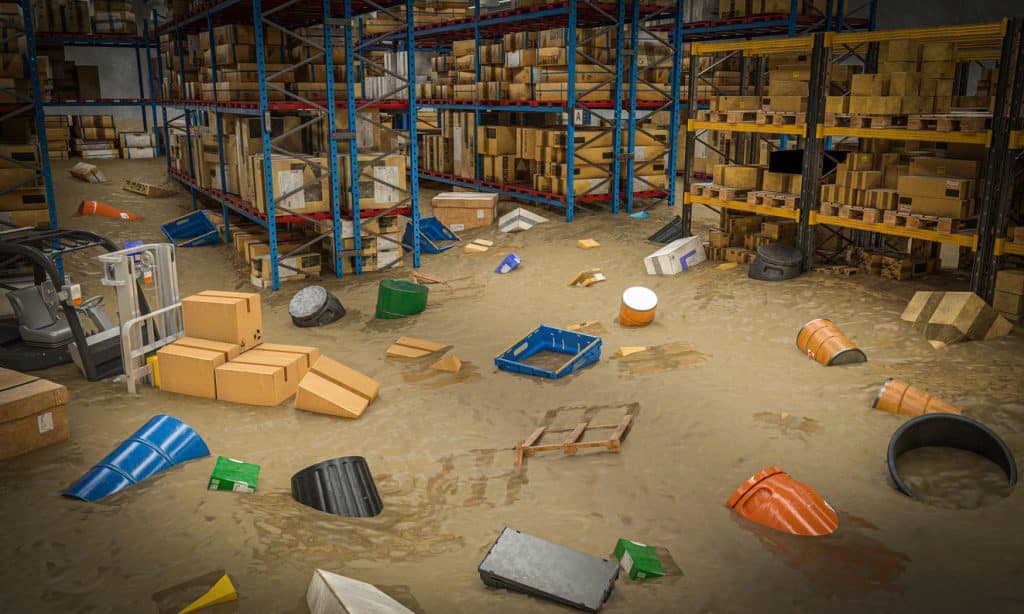
Production at two of the world’s largest HDD makers – Western Digital and Seagate – has been badly hit by the flooding (the worst in the country for more than a century), and it could be well into 2012 before they fully recover to normal output.

Toshiba and the HDD motor supplier Nidec have been affected too, with Nidec’s manufacturing facilities being inundated with water.

(Note: 60% of Western Digital’s HDD production is located in Thailand, along with 50% of Toshiba’s. Thailand is second only to China in HDD production.)

The HDD shortage is set to hit Notebook PC assembly/production the worst – sourcing HDDs from other suppliers will result in inevitable price rises.

Key questions to ask
The floods in Thailand have caused short-term price increases for all types of PCs, and will create shortages when manufacturers’ strategic stock runs out.

But

  • Could these shortages and the resulting supplier or sub-assembly supplier workarounds have been avoided?

And…

  • Did the PC manufacturers really understand the magnitude of their individual and collective dependency on one HDD supplier?

It’s the whole IT industry being impacted; those PC manufacturers who were most prepared with their contingency planning should be the ones that will fair best.

For some computer manufacturers and media player, set-top box and stand-alone hard drive producers, performing a supply chain risk analysis and quantifying the exposure (by sensibly investing in contingency planning/mitigations) before the floods will be feeling like their smartest business move ever now; acting on analysis findings will be providing them with a real competitive advantage.

Risk assessment and supply chain analysis is surely a ‘no brainer’ now?
Granted, the challenges facing companies in the technology industries (re: building resilience in their supply chains) are huge, with many firms claiming that, the speed of innovation is so steep, they never really have the time or resources to build true redundancy into their chains.

But surely the lesson from the Thailand flooding catastrophe is that making time to risk assess and analyse supply chains (by using a simple and effective tool like SCAIR, which helps to make sense of a complex area of risk) has to be at, or near, the very top of every type of aforementioned manufacturers’ ‘jobs to get done’ priority list from now on? Or at least well before the first raindrop of next summer’s Southeast Asia monsoon gently falls?

Sources:
www.channelregister.co.uk
www.digitaltrends.co.uk

Posted on November 19th, 2011.
Tags: risk, Supply Chain
Posted in Risk Management

Could the Impending ‘Solar Max’ be the Next Disaster to Hit Global Supply Chains?

Compared to sudden economic downturns, terrorist attacks, floods, earthquakes, tsunamis and the like, the next potential disaster to hit global supply chains could be pretty left-field. It’s all to do with the cyclic behaviour of the sun…

The sun’s magnetic field experiences cyclic changes that peak every 11 years (known as the ‘Solar Maximum’ or ‘Solar Max’). This is when the sun is at its most active and when severe space weather events can occur. The next Solar Max peak periods are due in 2011/12 and are predicted to be the most intense for 50 years.

The strongest solar activity was recorded in1957-8, when the world was on the verge of a technical revolution, having just catapulted Sputnik into space. Back then the US experienced a radio blackout that cut it off from the rest of the world, and voltages in electrical telegraph circuits exceeded 320 volts in Newfoundland. On that basis, the impact of the stronger activity that is predicted for 2012 is almost incomprehensible.

During a Solar Max, violent solar flares (atomic explosions) blast out from the sun at high velocity. Emissions from the flares (charged particles that form an ash cloud) produce intense bursts of radio noise that can disrupt GPS satellite navigation. Aircraft navigation systems can be particularly affected. And with the impending Solar Max having the potential to completely drown out GPS signals, the commercial aviation industry is understandably worried.

GPS is also used for emergency rescues and to synchronise power grids and mobile phone networks. Electrical disturbance and damage to power grids (caused by solar activity) can also result in closures of businesses, schools, hospitals, government buildings, etc. as well as disrupting countless domestic homes.

Returning to commercial aviation, although planes can fly without GPS, power outages can force air traffic controllers to increase the distance between aircraft, and to slow take-offs and landings, causing (massively expensive) flight delays.

Who would have thought that an ash cloud could create so much havoc!

The good news is that the potential threat of a Solar Max can be effectively risk managed. For any Risk Management/DR Specialist worth their salt, a Solar Max represents the ultimate challenge, in fact. A risk management expert will thrive on advising and guiding business infrastructure managers on the best ’solar flare-proof’ steps to take, such as the implementation of:

  1. A back-up generator supply - to ensure critical systems can be powered
  2. Financial exposure/loss minimisation strategies - data system and software back-up plans to maintain uninterrupted customer-related operations (customer-facing operations, customer-service provision, etc.) 
  3. Uninterrupted communication systems - for communication between management and staff, staff and customers…

These (and other safeguards) could mean the difference between a company continuing to trade as normally as possible during a Solar Max, or even going out of business altogether.

For any company, having a tailored contingent business-interruption plan in place well before the Solar Max is prudent. But understanding how resilient your global supply chains are to potentially catastrophic scenarios is paramount. With the next Solar Max drawing closer by the day, it’s essential for infrastructure managers to ACT NOW! 

Sources:
http://www.universetoday.com/14645/2012-no-killer-solar-flare/

http://www.newscientist.com/article/dn10189-solar-flares-will-disrupt-gps-in-2011.html

http://www.mekabay.com/infosecmgmt/solarmax.pdf

http://www.solarstorms.org/SRefStorms.html

Posted on October 4th, 2011.
Posted in Risk Management

Five Months On: The Japanese Tsunami’s Impact on Global Supply Chains

The tsunami in Japan in March this year caused a dreadful loss of life and unquantifiable human suffering. It also damaged the country’s economy and its industrial base. The full impact (in a broader, global sense), is more difficult to assess.

Five months on, has the predicted disruption to global supply chains (caused by the tsunami) really been as bad as initially forecasted? Or has it been ‘business as usual’ for the most part world-wide?

It all really depends upon just how much of a global ‘driving force’ Japan was at the time of the tsunami – how much sway Japan had on the world economy in the first place.

About Japanese car and steel production

The truth is that at the time of the disaster Japanese influence upon global supply chains overall was not as strong as one would think1, given the nation’s track record and reputation for being incredibly work-orientated, seemingly industrious to an almost inexhaustible level!

Granted, interruptions to Japanese car and steel production have, to an extent, impacted upon global supply chains, but this hardly constitutes a severe body blow to the world economy. In fact, the disruption to Japanese supply chains (for steel products and cars) may serve to create opportunities for suppliers in America, Europe and indeed other parts of Asia2.

What about the electronics industry?

Almost one fifth of all global technology products are made in Japan. And although some major importers of electronic products and components have other suppliers primed to ‘step in’ should their Japanese supply chain suddenly be interrupted, those without a good continuity plan have felt the frighteningly far-reaching effect of the tsunami. Significant supply chain interruptions were caused by the closure of several major Japanese ports and the temporarily closure one of the few silicon wafer foundries.

As a result of delays in the arrival from Japan of electronic components (semiconductors, silicon wafers and memory chips) and goods (digital cameras, music devices, laptops and televisions, etc)2, some manufacturers’ and retailers’ reputations across the Globe have been eroded, their sales have significantly dropped (with their profits plummeting in tandem, of course), and perhaps worst of all, once loyal customers are now buying their ‘must have’ video games, digital cameras, iPads, and widescreen TVs, etc., elsewhere.  Never to return?

Sony’s Troubles Mount
The natural disaster hit Sony hard in an already declining market and a period of unfavourable exchange rates. Sony’s Q1 results reported costs totalling $66m for restoration, loss of inventory and production downtime4. Additionally, Sony’s CPS and PDS segments saw a drop in sales due to the restricted availability of some components for certain product lines and decreased production capacity due to damaged manufacturing equipment.

Further supply chain problems were experienced in the UK on 8th August when Sony’s compact discs and DVDs warehouse in Enfield was burnt down during the UK riots. The warehouse was reported to be Sony’s only content products depot in the UK5. This certainly isn’t a good time for Sony, which is still reeling from the Play Station cyber-attacks that shut down parts of their network from April until July 2011.

References/Sources

1&2 Movehut / The Impact of the Japanese Tsunami

3 Freightwatch / Japan Earthquake and Tsunami and the Impact on the Electronics Supply Chain Industry

4 http://www.sony.net/SonyInfo/IR/financial/fr/11q1_sony.pdf

5 http://www.theregister.co.uk/2011/08/09/sony_warehouse_london_riots/

Posted on August 24th, 2011.
Posted in SCRM News

Did you miss the Supply Chain Risk newsletter?

If you missed our latest newsletter you can follow this link to see a roundup of key Supply Chain issues and developments aimed at helping supply chain managers and professionals to minimise exposure and manage their company’s vulnerabilities.

Posted on April 5th, 2011.
Posted in Risk Management

White Paper: Industry Contagions Buried Deep in Supply Chains

In today’s global supply chains, the threats that are most likely to elude identification are those buried deep in an organisation’s upstream supply chains. The loss of a direct, single source of a key material could prove a major headache for one company, but what happens if the common source of an industry feedstock should fail?

Systematic supply chain analysis and quantification of the value at risk can help to identify critical exposures and justify practical mitigating actions, such as establishing alternative sources in geographically distinct areas, or holding more strategic stock. The following article considers a number of events which have had global consequences and lays down a challenge to industry to work together to find mutual mitigations… Click here for the complete Supply Chain Risk White Paper.

Posted on April 3rd, 2011.
Tags: risk, Supply Chain, white paper
Posted in Risk Management

Australian Floods Impact Global Supply Chains

Mining and Steel – What’s the immediate impact and long term outlook?

The impact of the devastating floods in Queensland will be felt through global supply chains for many months to come. Almost 70% of global steel production is dependent on metallurgical or coking coal. Australia produces two-thirds of global exports of coking coal, of which Queensland accounts for 35%.

Many major mining companies in Queensland have invoked force majeure clauses, which have temporarily released them from contract obligations. This has forced Asian steel-makers who buy the bulk of Australia’s coal, to find alternative sources including Russia, China, United States and Canada. These sources and inventories will keep steel plants running normally over the next few weeks, but the real impact on the steel industry will not be known until safety stocks are exhausted.

Lost Sales, Multiple Supply Chain Disruptions

As of 16th January 2011, the Queensland Resources Council estimates that the region’s coal sector has lost sales worth A$2.3 billion since the beginning of December. It is predicted that the disruption could remove over 5 percent of coking coal from world markets this year and inflate prices by a third or more.

About 40 mines in Queensland have been significantly affected by the floods. Many will take weeks to pump out the flood water and rebuilding critical infrastructure may take longer. Major coal rail lines in the Bowen Basin have been submerged or washed away. The port of Gladstone with a daily export capacity rate of 200,000 tonnes stopped receiving coal shipments on 31st December and only now is planning to resume shipments at 50% of capacity (20th Jan). It is likely to be the end of March before it is back up to full capacity.

Recovery from Previous Disasters

The mining industry has shown great resilience in the recent past: ‘In 2008, flooding kept some mines out of action for as much as six months, but others were able to start producing within four to six weeks’, said Andrew Harrington, an analyst at Patersons Securities in Sydney. Mines then increased their outputs to end the year about 10 percent below their original targets.

Insurers ‘Steeling’ Themselves for Major Losses

Yesterday, the ‘Insurance Day’ in London reported on insurers preparing for a surge of business interruption claims from the mining sector. This disaster looks set to exceed the Australian floods of 2008, which racked up a total of $1.5b in claims.

Posted on January 20th, 2011.
Tags: force majeure, global impact, safety stock, Supply Chain disruption
Posted in SCRM News

Supply Chain Impact of Water Shortages

Whilst the December snowfalls have taken their toll on the UK’s ability to deliver Christmas goodies, the impact of the thaw is creating further disruption for many companies. The water shortage in Northern Ireland is continuing to affect a huge number of home owners, but how are businesses coping across the area?

For manufacturing sectors such as food, pharmaceuticals and chemicals, water can be a critical dependency in many ways:

  • As an essential ingredient.  Take a well-known producer of soups in Ireland. Only a year ago, Batchelors faced a shut down as a result of burst pipes and the resulting drain on reservoirs.
  • Sanitation of processes and personnel. If work conditions become insanitary the workforce has to go home, vessels cannot be cleaned to required standards.

Perhaps your next supply chain risk assessment, should give some thought to the following:

  • How reliant is your business on the robustness of your local water supply?
  • What would the cost of a prolonged water shortage be to your business?
  • Does that justify further investigations into alternative emergency supply options?

It isn’t simply a winter problem. Water rationing in dry spells has the potential to cause disruptions that could go on for even longer.

Posted on January 4th, 2011.
Tags: alternative sources, critical dependency, process disruption, supply chain risk assessment, Water shortage
Posted in SCRM News

Severe Weather Tests Supply Chain Contingency Planning

There certainly is a spectrum of views on the UK’s ability to plan for and react to extreme weather events. These range from the average man on the street complaining that the UK will always grind to a halt after only 1 cm of snow, to the opinion that we are learning from previous cold weather experience and beginning to become more resilient as a nation.

The recent performance of BAA and Northern Ireland Water suggest that the contingency plans of some infrastructure organisations have not accounted for extreme disruption scenarios. However, there may be some small glimmer of light at the end of the tunnel in the form of a review of the local authorities’ response to this year’s cold snap. This complementary report indicates that the local authorities have learnt lessons from the previous two winters.

Can any differences in performance between local authorities and infrastructure organisations be attributed to the difference in mandatory contingency planning requirements for first responders (governmental bodies, the NHS) and second responders (utility companies)?

Or is it more to do with the level of scrutiny following the disruption during the previous two winters (reported to cost the UK economy £1bn), which resulted in the Winter Resilience Review (final findings published Oct 2010)?

Either way, UK Plc appears to have applied some sound supply chain risk management principles in order to improve their local response efforts to the December snowfalls, namely:

-          Alternative sourcing options. By exercising ‘contingency’ contracts, farmers and their tractors were quickly mobilised with their snow ploughs to clear the highways.

-          Increased buffer stock. Following the well-publicised shortage of gritting salt last year, the government has taken decisive action to increase the national salt stock pile and then make local authorities pay through the nose if their own stocks are inadequate and they need more in a hurry.

As with most supply chain contingency planning, it’s all about justifying the investment in the solution by quantifying the potential impact of the threat.

Posted on December 30th, 2010.
Tags: Business Continuity, Contingency planning, Extreme disruption, Scenario planning, Severe weather event
Posted in SCRM News

SCAIR takes over SCRM where ERP systems stop

Some ERP systems, such as SAP, JD Edwards and Dynamics have very strong Supply Chain functionality, however do not focus on the SCRM issues addresses by SCAIR.

Whilst ERP systems manage the resources, SCAIR translates the financial impacts and is a very cost effective method of interpreting the outputs from ERP systems into valuable management information for mitigating the impact of supply chain failures.

Posted on December 8th, 2010.
Posted in Risk Management

« Older Entries
Copyright InterSys Ltd | SCAIR™ - Risk Exposure Quantification Software
Sitemap | Privacy policy | Terms and conditions